

Men’s Health Week – 15th To 21st June 2026
Pushing none NHS healthcare or simply encouraging men to seek advice and help?
Next week is the first Men’s Health Week since the publication of the Government’s document on Men’s Health last November and reported by Unionsafety here
The Men’s Health Strategy is of course relevant to Men’s Health Week 2026, taking place 15th to 21St June.
This year, Men’s Health Forum charity has produced a report into the low use by Men of England’s pharmacies, entitled "An Unfilled Prescription". So, what would encourage men to speak to a pharmacist? Extended opening hours, often assumed to be a key factor for working men, ranked relatively low suggesting that men prioritise the quality and legitimacy of care over accessibility. The importance of NHS integration also stands out says the report: An increasing problem though is not covered by the report, and that is one of availability. You can access more information from the Unionsafety E-Library, including the Men’s Health Forum’s report: "An Unfilled Prescription" by clicking the image of the report above right. Get the Executive Summary of the report here Source: Men's Health Forum / unionsafety
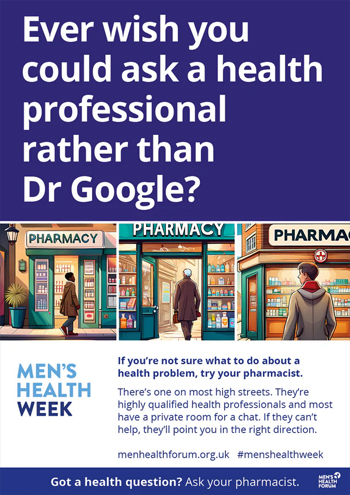 The report highlights a golden opportunity to convert men's regular presence in pharmacies into a triple win:
* boosting men's health,
* improving pharmacy footfall and
* reducing pressure on the NHS.
While most men regularly use a pharmacy, very few of them ever discuss their health with a pharmacist so there's a lot of potential, claims the report.
That said, Men’s lower level than women, of engagement with their GPs, is also an area of concern, not addressed by this report which clearly promotes pharmacies in England as an alternative to visiting a doctor and is in line with this Government’s policy of pushing healthcare generally in the direction of private providers to reduce the workload on GPs and to enable their intentions to not recruiting more GPs.
Nevertheless, the report for this year’s Men’s Health Week, can only act as encouragement for men to seek advice and support for their health.
The report gives an insight into why men don’t talk to pharmacists when they attend a pharmacy to collect over the counter medicines or a prescription, The report says:
When asked why they do not seek advice from pharmacists, men cite a combination of structural, cultural, and relational barriers:
> A preference for seeing a GP or another healthcare professional
> Perceived high cost of pharmacy products
> Discomfort discussing health concerns in a public retail space
> Lack of a personal relationship with the pharmacist
> Previous unhelpful experiences
Notably, a significant minority of men (around 17%) do not believe pharmacists can provide the help they need. This persists despite very high awareness (when prompted) of pharmacists’ professional qualifications.
Age is a factor. Men aged 18–24 years are far more likely to rely on family members for health advice, whereas men aged 25–34 years are the most likely to prefer GPs over pharmacy.
Older men may be less likely to want to discuss their health in a pharmacy: more than 25% of men aged over 55 years say they feel discomfort about discussing health concerns in the pharmacy environment.
Men were also asked what would make them more likely to use pharmacy services. The top motivators point toward integration, privacy, and credibility, rather than convenience alone:
> Knowing the pharmacist could refer them into the NHS if needed (25.86%)
> Knowing conversations would be private (24.02%)
> Knowing they could get specific, tailored advice (24.02%)
> Knowing information could be shared with their GP (21.02%)
men want reassurance that pharmacy is not a stopgap alternative, but a gateway into the wider health system.
Too many pharmacies are run by commercial venture’s and often have only 1 pharmacist on duty on certain days, because of sharing the pharmacist with other branches of the chain in order to cut costs and improve profit margins.
This too is happening in GP surgeries, with GPs being shared across practices.
Given these circumstances, it is hard to see how more men will be encouraged to seek help and support for their physical and mental health due to a lack of resources.
In short, both the Men’s Health Strategy document and that of Women’s Health are not being properly resourced.
